Showing posts with label interdisciplinaritate. Show all posts

Monday, April 22, 2013

Computers & Education

Computers & Education, An International Journal (ISSN: 0360-1315, 5-Year Impact Factor: 2.970), Imprint: ELSEVIER.
About this Journal: Computing and communication technology continue to make an ever-increasing impact on all aspects of cognition, education and training, from primary to tertiary and in the growing open and distance learning environment. The journal is an established technically-based, interdisciplinary forum for communication in the use of all forms of computing in this socially and technologically significant area of application and will continue to publish definitive contributions to serve as a reference standard against which the current state-of-the-art can be assessed.
Ref.:
- http://www.journals.elsevier.com/computers-and-education
- http://www.sciencedirect.com/science/journal/03601315

"In the higher education classroom, the textbook is one of the many tools used for learning. In some courses, the textbook is central to class discourse. In other courses, the text is supplementary and acts as a guide for segueing among the topics covered. Whatever role the faculty chooses for the textbook to play in the course, instructors and students alike consider the textbook an essential learning tool. In this digital age, the nature of the textbook is changing. Eighty percent of college and university students own laptops, and an increasing number are purchasing tablets, smart phones, and other handheld devices (Smith & Caruso, 2010). Recognizing the increased adoption of mobile devices, publishers are offering an increased number of textbooks in digital format. These digital texts, also called e-textbooks, can be accessed via the Internet and downloaded on tablets, e-readers, smart phones, and laptops. The adoption of e-textbooks, along with the broad range of interactive learning features, is projected to exponentially grow within the next two to three years (Becker, 2010; Reynolds, 2011). Unfortunately, as is true with many technological advances, the educational research to support the efficacy of e-textbooks consumed via mobile devices lags behind development and adoption."
Autors: Amanda J. Rockinson- Szapkiw*, Jennifer Courduff, Kimberly Carter, David Bennett,  Electronic versus traditional print textbooks: A comparison study on the influence of university students’ learning, Computers & Education 63 (2013) 259–266, ISSN: 0360-1315, Elsevier Ltd. (Impact Factor: 2.970)
Ref: www.journals.elsevier.com/computers-and-education , www.sciencedirect.com/science/journal/03601315


Tuesday, November 6, 2012

10 ani de CNIV

În anul 2012, după 10 ani de activităţi complexe şi diverse în cadrul proiectului educaţional CNIV: prin parcurgerea unor etape, lucrul în echipe şi prin activităţi colaborative, produsele de e-Learning şi Software educaţional înglobează nu numai experienţa specialiştilor în informatică şi IT, dar mai ales scenarii didactice şi pedagogice destinate procesului de învăţare în beneficiul elevilor şi studenţilor.

La ediţia aniversară de la Braşov, în prezidiul Conferinţei au participat:
Prof. dr. Marin Marin, Decanul Facultăţii de Matematică şi Informatică din Braşov, Conf. Dr. Marin Vlada, coordonatorul proiectelor CNIV şi ICVL de la Universitatea din Bucureşti, Prof. Radu Jugureanu, Director AeL eContent, Siveco România, Prof. dr. Ion Roceanu, Universitatea Naţională de Apărare “Carol I”, Prof. Dr. Grigore Albeanu, co-preşedinte ICVL, Conf. Dr. Adrian Adăscăliţei, Universitatea Tehnică “Gh. Asachi” din Iaşi şi Conf. Dr. Marius Păun, Dir. Departament al Facultăţii de Matematică şi Informatică din Braşov.
La deschiderea în plen a evenimentelor a participat şi a luat cuvântul Prof. dr. Vasile Preda, de la Facultatea de Matematică şi Informatică din Bucureşti, Decan în perioada 2000-2004, când s-a desfăşurat CNIV 2003, prima ediţie a Conferinţei Naţionale de Învăţământ Virtual. Amimtim faptul că prima ediţie CNIV s-a desfăşurat la Facultatea de Matematică şi Informatică din Bucureşti în colaborare cu Facultate de Chimie a Universităţii din Bucureşti.

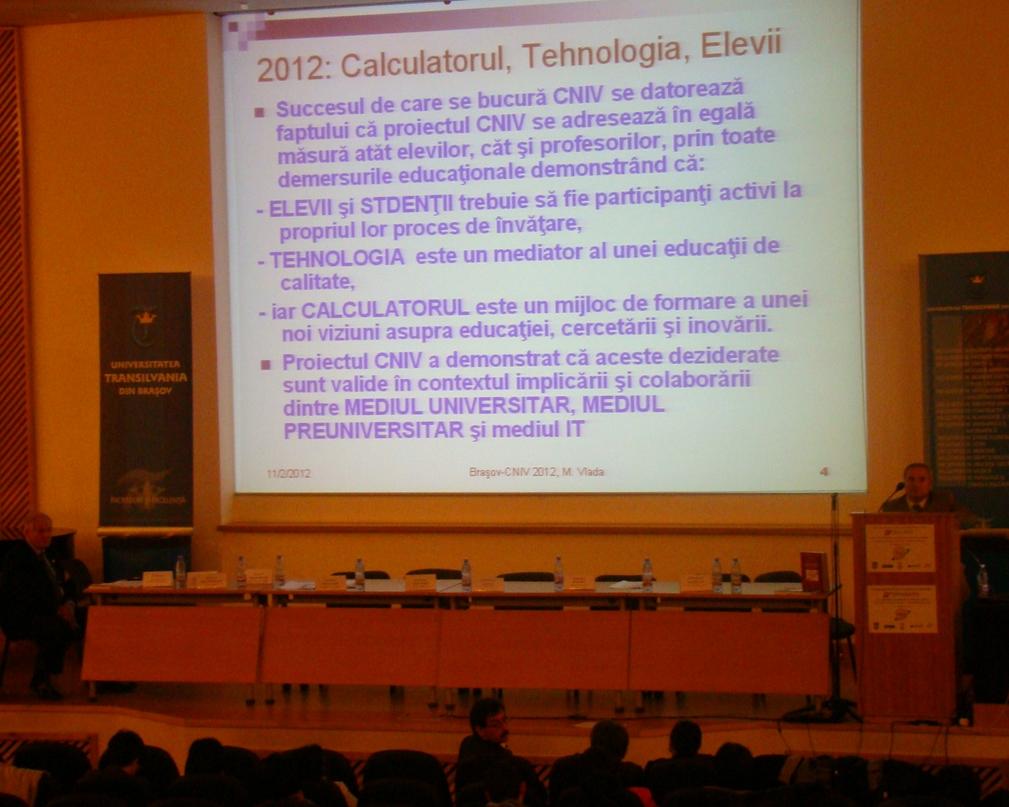
Succesul de care se bucură CNIV se datorează faptului că proiectul CNIV se adresează în egală măsură atăt elevilor, căt şi profesorilor, prin toate demersurile educaţionale demonstrând că: ELEVII şi STUDENŢII trebuie să fie participanţi activi la propriul lor proces de învăţare; TEHNOLOGIA este un mediator al unei educaţii de calitate; iar CALCULATORUL este un mijloc de formare a unei noi viziuni asupra educaţiei, cercetării şi inovării. Proiectul CNIV a demonstrat că aceste deziderate sunt valide în contextul implicării şi colaborării dintre mediul universitar, mediul preuniversitar şi mediul IT.
Ref.: www.topub.unibuc.rohttp://www.agora.ro/http://eduvision.ro/ , http://www.elearning.ro/

Wednesday, August 22, 2012

Mercator projection - first map of the world

Proiecţia Mercator si prima hartă a lumii

Gerardus Mercator (1512 -1594) was a cartographer, philosopher and mathematician. He is best known for his work in cartography where he created the Mercator projection world map.  

2012 marks the 500th anniversary of Mercator's birth.

Ref.:
- http://en.wikipedia.org/wiki/Gerardus_Mercator
- http://vcn.weblog.ro/
- http://www.mercatornet.com/info/mercator_who/
- http://www-history.mcs.st-and.ac.uk/

Sunday, November 20, 2011

InTech - Books and Journals


InTech is a multidisciplinary Open Access publisher of books and journals covering the fields of Science, Technology and Medicine: www.intechopen.com

InTech is a world leader in the provision of STM Open Access content, including books and journals. We break down the traditional barriers to becoming published and provide authors with new choices and an equal opportunity to share their ideas and the results of their research with the global scientific community.

Ref.: http://www.intechweb.org/


Saturday, August 13, 2011

Complexity of learning process


Learning is a process.

1. What is "complexity"?
2. Predictability, Complexity, and Learning
3. Learning environments are increasingly complex ?
4. Adaptive governance, networks and learning
5. Principles of Learning

Image: Animation of Learning Process, SWWRocBot, A Unique Learning Environment
By Nick Clark, http://swwrocbot.blogspot.com/

Read more: www.unibuc.ro/prof/vlada_m/

Learning from projects and practice

Complexitatea procesului de invatare (in Romanian)

De-a lungul vremii, in toate domeniile stiintifice se schimba teoriile, metodele si tehnicile de investigare, de aceea dinamica cunoasterii umane influenteaza dezvoltarea generala a societatii umane. Pentru a obtine evolutie si eficienta in viata sa, omul trebuie sa se adapteze continuu la aceste schimbari ale cunoasterii. In domeniul educatiei, si in special al invatarii si perfectionarii, aparitia de noi tehnologii ale informatiei si comunicarii (TIC), imbunatatirea teoriilor pedagogice si psihologice, obliga pe elevi/studenti, profesori, parinti si pe specialisti, sa se adapteze la aceste schimbari.


Ce fac elevii si studentii? Ce fac profesorii si parintii? Ce fac specialistii? Ce fac guvernele tarilor?

Models and Solutions: SWWRocBot
An Example
SWWRocBot, A Unique Learning Environment by Nick Clark (Information Science & Learning Technologies, Robotics Coach, School Without Walls); SWWRocBot is a site laying out the Challenges, Solutions and Results that are the foundations of a unique learning environment.
This learning environment is based on the work of Nick Clark, author of "The Geometry of Learning and the Architecture of Knowledge". It will be a multi-disciplinary, interactive and immersive experience (See animation above) with positive outcomes for the following stake holders:
-Students
-Parents
-Teachers
-Administrators
-Mentors
-The School (School Without Walls)
-The City School System
-Community Business Partners
-Community Organization Partners
-Individuals whose talents are required for the success of the program
Source: http://swwrocbot.blogspot.com/

The Need for Clear Definitions
"In any scientific discipline there are many reasons to use terms that have precise definitions. Understanding the terminology of a discipline is essential to learning a subject and precise terminology enables us to communicate ideas clearly with other people. In computer science the problem is even more acute: we need to construct software and hardware components that must smoothly interoperate across interfaces with clients and other components in distributed systems. The definitions of these interfaces need to be precisely specified for interoperability and good systems performance. Computer science already has a number of useful clearly defined models of computation whose behaviors and capabilities are well understood. We should use such models as part of any definition of the term computation. However, for new domains of investigation where there are no appropriate models it may be necessary to invent new formalisms to represent the systems under study."
Alfred V. Aho (Lawrence Gussman Professor in the Computer Science Department at Columbia University).

Ref.: http://ubiquity.acm.org/article.cfm?id=1922682


1. What is "complexity"?

Melanie Mitchell (Professor of Computer Science at Portland State University): I would call this a "deceptively simple" question—in fact, it is one of the most difficult questions of all! The field of complexity arose out of the strong feeling of some scientists that there are deep similarities among certain highly "complex" systems in nature, society, and technology. Examples of such systems include the brain, the immune system, cells, insect societies, economies, the World Wide Web, and so on. By "similarities," I don't mean that there are necessarily a single set of principles that governs these disparate systems, but rather that all these systems exhibit behavior that has been described as "adaptive," "life-like," "intelligent," and "emergent." None of these terms have precise meanings, yet, which makes a formal definition of "complex system" impossible at this time. A system with large numbers of interacting components, in which the components are relatively simple compared with the system as a whole, in which there is no central control or global communication among the components, and in which the interactions among the components gives rise to complex behavior. Here, "complex behavior" refers to the informal terms (e.g., adaptive, emergent) that I listed above.

Ref.: Ubiquity, Volume 2011, Number April (2011), Pages 1-6, http://ubiquity.acm.org/article.cfm?id=1967047


2. Predictability, Complexity, and Learning

"One of the most important examples of prediction is the phenomenon of generalization in learning. Learning is formalized as finding a model that explains or describes a set of observations, but again this is useful only because we expect this model will continue to be valid. In the language of learning theory (see, for example, Vapnik, 1998), an animal can gain selective advantage not from its performance on the training data but only from its performance at generalization. Generalizing—and not “overfitting” the training data—is precisely the problemof isolating those features of the data that have predictive value (see also Bialek and Tishby). Furthermore, we know that the success of generalization hinges on controlling the complexity of the models that we are willing to consider as possibilities.”

Predictability, Complexity, and Learning, Neural Computation 13, 2409–2463 (2001) (Articles Communicated by Jean-Pierre Nadal) by William Bialek (NEC Research Institute, Princeton, U.S.A.), Ilya Nemenman (NEC Research Institute, Princeton, New Jersey, U.S.A., and Department of Physics, Princeton University, Princeton, U.S.A.), Naftali Tishby (NEC Research Institute, Princeton, U.S.A., and School of Computer Science and Engineering and Center for Neural Computation, Hebrew University, Jerusalem, Israel)
Ref.: http://www.princeton.edu/~wbialek/our_papers/bnt_01a.pdf


3. Learning environments are increasingly complex?

Book - Handling complexity in learning environments: theory and research
By Jan Elen, Richard Edward Clark, Joost Lowyck, European Association for Research on Learning and Instruction, 2006, Elsevier Ltd.
What do we mean when we say that "learning environments are increasingly complex"? What do we know about the cognitive processing that occurs during complex learning? How can we provide effective instructional support for students who must learn and apply complex knowledge? These questions, and related issues, have fascinated educators and educational researchers for many years and are they are the focus of this book.

Ref.: http://books.google.com/


4. Adaptive governace, networks and learning
“Learning is therefore essential for stakeholders to develop their ability to deal effectively with new situations and to prepare for change and surprise.” Örjan Bodin ( Adaptive governance, networks and learning)

Ref.: http://www.stockholmresilience.org/2218.html
Halldén, O., Lundholm C. (2009). 25-30 August. Conceptual Change and the Complexity of Learning. Threshold Questions, Meaning making and Contextuality. Paper presented at the 13th conference European Association for Research on Learning and Instruction, Amsterdam, Holland.

5.Principles of Learning
- Organizing for Effort
- Clear Expectations
- Fair and Credible Evaluations
- Recognition of Accomplishment
- Academic Rigor in a Thinking Curriculum
- Accountable Talk®
- Socializing Intelligence
- Self-management of Learning

Ref.: http://ifl.lrdc.pitt.edu/

"Research in education demonstrates that, by working hard, virtually all students are capable of high achievement. These findings have caused educators to recognize the primacy of effort, rather than following ingrained assumptions about innate aptitude. Effort-based education research has started to demonstrate that properly focused student efforts not only yield high achievement for all students, but can actually create ability. People can become smart by working hard at the right kinds of learning tasks." Institute for Learning (IFL), University of Pittsburgh.
- http://www.instituteforlearning.org/


Friday, August 5, 2011

21st Century Fluencies for the Digital Age


21st Century Fluencies for the Digital Age Project

Ref.: http://www.fluency21.com

Literacy is NOT Enough: 21st Century Fluencies for the Digital Age

Powerful technologies and information systems have caused facts to become obsolete faster, and knowledge built on these facts to become less durable.

Literacy is NOT Enough: The New Learning Process

The New Learning Process covers a fundamental shift in the basic paradigm of teaching that is required to prepare digital students for 21st century life.

What do we do with all this information?

Our society has been irreversibly affected by a new phenomenon in InfoWhelm - an unparalleled access to a wealth of online information, never before seen or heard of. Learning has truly become a lifelong pursuit, and it can happen anytime and anywhere in our Information age. But how do we determine good from the bad, interpret right from wrong, and distinguish complete, accurate, and usable data from a sea of irrelevance and digital inundation? The skills to help us best understand and make use of the wealth of knowledge at our fingertips is essential to life and success both in the classrooms and workforces of the 21st century

Ref.: http://www.fluency21.com

http://www.committedsardine.com/presentations_LNE.cfm

http://www.youtube.com/v/7ECAVxbfsfc?f=videos&app=youtube_gdata


Monday, June 27, 2011

Prof. Radu Jugureanu


Prof. Radu Jugureanu
AeL eContent Department Manager.

Update (in romanian) iulie 2019: https://radioromaniacultural.ro/

Prof. Radu Jugureanu studied Mathematics at the University of Bucharest, Faculty of Mathematics and Computer Science. After graduating he was a Math and Computer Science teacher at Cantemir High School Bucharest. He continued his education gaining the following diplomas: Management in youth organizations, Senior Teacher in non-formal education and CISCO Certified teacher for CNAP.

  • From 2003 he is a Project Manager in SIVECO Romania SA, leading the Educational Software Department, where are developed the educational multimedia courses for more high schools and gymnasiums, within the IT-Based Educational System project, which implement the IT&C in Romanian schools.

  • In 2005, at World Summit for Information Society, the educational multimedia content developed by the SIVECO team, led by Radu Jugureanu, won "The World’s Best eContent" in the category of e-Learning, from 168 countries.

(eduVision 2020, 1st edition, 2011 | http://www.eduvision.ro/speakers.html)

- Articol Money Express - 22.09.2011: eduVision 2020- primul pas

(Online Educa Berlin 2006 | http://www.online-educa.com/)

- Scoala viitorului, Cum arată „Clasa viitorului“ în viziunea companiei SIVECO?, 2013/2014 , http://www.marketwatch.ro/

- Iunie 2013 - "La Congresul Educației au fost prezentate modele de conţinuturi
educaţionale bazate pe curriculum integrat transdisciplinar pentru matematică şi ştiinţe şi discipline socio-umane, utilizând tehnologii dedicate, precum tablete cu sisteme de operare Windows şi Android, ecrane de proiecţie, table interactive, dispozitive multi-touch, tehnologia augmented reality". SIVECO Romania.


Ref.:
- http://advancedelearning.com
- http://c3.cniv.ro/, http://c3.icvl.eu/
- http://adlunap.ro/else2011/
- Publicatii (2003-2010):
http://iteach.ro/ (pdf)

Note (About Siveco): eLearning Awards 2010 for IT basesd Education System; SEI - The IT-Based Educational System (Romania)- SIVECO Romania receives Gold Winner title at eLearning Awards 2010 competition for The Romanian IT-based Education System (SEI), in the category "Best e-learning project securing Widespread Adoption"


Întrebări globale (Radu Jugureanu)
Update: "Şcoala are misiunea dificilă de a se reinventa: Şcoala viitorului înseamnă să uiţi că există metodologia predării" - www.marketwatch.ro

Care este rolul meu, al profesorului?
1. Să imi pregătesc elevii/studenţii să lucreze în locuri de munca ce astăzi nu există
2. Să imi pregătesc elevii/studenţii să lucreze cu tehnologii neinventate încă
3. Să îmi pregătesc elevii/studenţii să rezolve probleme despre care încă nu ştim că ar fi probleme
Cu ce instrumente trebuie să ”reuşesc” să fac toate acestea?

e-Learning = Learning

"Educaţia asistată de computer permite abordarea sistemică a instruirii, o nouă viziune pe care psiho-pedagogia o teoretizează în ultimii ani, dar care devine operativă în momentul în care strategia didactică se împleteşte cu tehnologiile multimedia. Astfel, dacă în instruirea gândită ca sistem se pot determina: scopul sistemului (obiectivele instruirii), procesele prin care este atins scopul (tipul de activităţi, situaţii de învăţare, la care trebuie să participe elevii pentru a atinge obiectivele fixate) şi rezultatele la care se doreşte să se ajungă (traduse în categorii de achiziţii efective ale elevilor), proiectarea softului educaţional permite chiar acoperirea principalelor elemente constitutive ale sistemului, contribuind la optimizarea procesului de învăţare." Radu Jugureanu şi Delia Oprea

"Experienţa pe care am dobândit-o în ultimii zece ani în domeniul eLearning, ca arhitect, realizator şi implementator al soluţiilor naţionale pentru utilizarea tehnologiilor IT în instruire şi formare, atât în România- prin programul naţional Sistem Educaţional Informatizat, dar şi în ţări precum Azerbaidjan, Cipru, Maroc, Emiratele Arabe Unite, ca şi influenţa pe care instituţii internaţionale importante (Cambridge University Press, eLSE, CNIV/ICVL, OnLine Educa Berlin) au avut-o asupra pregătirii mele continue, îmi oferă suportul necesar pentru a iniţia o cercetare în identificarea acelor mijloace noi de formare şi instruire într-un domeniu atât de important cum este educaţia, în particular militară." Radu Jugureanu

Lecţii interactive AeL
Motto:
89% dintre elevi transformă obligaţia în motivaţie prin utilizarea lecţiilor AeL ca mijloc complementar de educaţie” E. Noveanu, D. Potolea, colectiv, Evaluarea SEI, 2008, Universitatea din Bucureşti, ISE, Centrul pentru Inovare în Educaţie (TEHNE Romania)

"Lecţiile interactive reprezintă un instrument puternic şi flexibil cu ajutorul căruia profesorul poate completa procesul tradiţional de predare prin motivarea elevilor şi prin îmbinarea diferitelor sisteme de predare. Astfel, elevii sunt stimulaţi să experimenteze ceea ce învăţa, să aplice în practică cunoştinţele dobândite, procesul de instruire devenind mult mai eficient." Radu Jugureanu

"AeL eContent foloseste metode didactice active, care stimuleaza implicarea cursantilor prin explorare, observare, studii de caz, simulari, execitii, jocuri educationale si portofolii. Aceste metode mobilizeaza cu succes energia cursantilor captandu-le atentia, sporindu-le interesul si stimulandu-le curiozitatea naturala, capacitatea de memorare si de intelegere. AeL eContent poate fi tradus in orice limba si poate fi localizat pentru orice tara, respectand specificul cultural, social si educational al regiunii" Radu Jugureanu

Project Based eLearning

Lucrare la CNIV 2009, Iasi: Perspective ale instruirii bazate pe proiect. Utilizarea aplicatiilor multimedia si multisenzoriale,
Jugureanu Radu, Profesor, AeL eContent Department Manager
Roceanu Ion, Prof. univ. dr., ADL Department Manager, Universitatea Naţională de Apărare Carol I

Ref.: http://cnmesm.wikispaces.com/ (video: Un moment de respect, Ce ştim să facem?, Există tehnologie)

International recognition
Commissioner Jan Figel was impressed by the results of the eLearning Romanian Program and stressed the modernization of the Romanian education system as one of the most advanced and coherent in Europe, a guarantee for Romania's transition to the Information Society and Knowledge Based Economy and a best practice for the region.


The skills and capacity to effectively transform knowledge and information into innovative products and services will" define successful Knowledge Economies in a society that has reconsidered its strategic priorities. Knowledge and information have become the most important ingredients for productivity and competitiveness and increased wealth and prosperity. A relevant education is more important today then ever, because today's world demands a workforce that understands how to use technology as a tool to increase productivity and creativity". Jan Figel


Sunday, June 5, 2011

Philosophy of life, music, and dance


Learning Meaning of Life from Nature

"Most theories and concepts will not help right now to understand life and its meaning, we have to conceive this our self directly from the nature, our surrounding, present and past, once we have developed our own convincing view we can extend this knowledge, refine it further with additional material, other sources." www.philosophyinlife.info/

What Is The Meaning of The Life

www.philosophyinlife.info/293/what-is-meaning-of-life.htm
Ref.: http://www.lumosity.com/landing_pages/42

‘Meaning’ is a creation of the mind. What I’m writing here has ‘meaning’ and it is a creation of my mind. And I enjoy the process. But my real happiness does not come from writing these words. Rather, it comes to me when my busy mind takes a break and I sink into a deep relaxation while remaining in a fully aware state. It is this internal reality which, for the most part, enables me to remain good-natured and happy in this hectic and unstable world. So, I love to play in the realm of ‘meaning’, but it is not ‘meaning’ which is foundation of my life.
by Duart Maclean http://anthonyduartmaclean.blogspot.com

"Life forces us into communities, but basically communities are war zones camoufl aged over with platitudes about caring, sharing and cooperation. If this were not so, there would not be such high rates of depression, burnout, substance abuse, divorce and suicide. There would not be so much costly litigation. The transformed leader who has attained a high degree of Self-awareness is able to see through the veil of separation and recognize his own self in the other. This is known as empathy, but there cannot be empathy where there is fear. So long as we perceive ourselves as isolated we will be dominated by fear and unable to experience true empathy for others. The deeper our sense of isolation, the more remote and inaccessible we become. When we are able to feel empathy, as distinct from attachment or sentimentality, others are attracted to us and this is the real basis for creating participation in our life and projects." by Duart Maclean, Creating Participation: http://anthonyduartmaclean.blogspot.com/2011/04/creating-participation.html

Learn from all ...

Learn from flower ...
Learn from lamb ...
Learn from birds ...
Learn from all ...

in romanian ...
INVATA de la toate ... (muzica: Adriana Ausch) ...

Învaţă de la floare să fii gingaş ca ea.
Învaţă de la miel să ai blândeţea sa.
Învaţă de la păsări să fii mereu în zbor.
Învaţă de la toate că totu-i trecător.

- www.youtube.com/watch?v=_7p4RdBL2Y4&feature=related


NOTA: Unii spun ca ceste versuri ii apartin lui Rabindranath Tagore (indian), altii spun ca versurile apartin scriitorului Traian Dorz.


in romanian
- "Oare vitregia vietii nu constituie tocmai piatra de incercare a adevaratelor caractere ?" Lucian Blaga
- "Filosofice sunt acele gandiri care intemeiaza oameni." Lucian Blaga
- "Se pare ca lumea este astfel intocmita ca sa nu poti gasi fericirea in ea, iar natura omului s-o caute vesnic. Acesta-i fondul tragic al existentei."
Lucian Blaga

“Eu nu strivesc corola de minuni a lumii
şi nu ucid
cu mintea tainele, ce le-ntâlnesc
în calea mea
în flori, în ochi, pe buze ori morminte.”
Source: www.romanianvoice.com/poezii/poeti/blaga.php

“Alunga patimile mele,
Pe veci strigarea lor o frânge,
Si de durerea altor inimi
Învata-ma pe mine-a plânge.
Nu rostul meu, de-a pururi prada
Ursitei mastere si rele,
Ci jalea unei lumi, parinte,
Sa plânga-n lacrimile mele.”

Octavian Goga – Rugăciune (1905)
Source: www.romanianvoice.com/poezii/poezii/rugaciune_og.php


Goran Bregovici

- www.youtube.com/watch?feature=related
- www.youtube.com/watch?v=KtX-V4OE50Y&feature=related
- www.youtube.com/watch?v=CYryevHIZGw&feature=related
- www.youtube.com/watch?v=AKRCo3347fw&feature=related


Zorba (Syrtaki) - Jakub Zajaczkowski

http://www.youtube.com/watch?v=AlNtTMJAQpg&feature=related
http://www.youtube.com/watch?v=zpOAnWEyzt8&feature=related
http://www.youtube.com/watch?v=dzlcxN0lxSo&feature=related


http://www.youtube.com/watch?v=IeBxzpwGh_A&feature=related

Ukraine - Eurovision 2004 - Ruslana
http://www.youtube.com/watch?v=48XfMRxp6IM&feature=fvwrel
EUROVISION 2009 WINNER -NORWAY ALEXANDER RYBAK FAIRYTALE -HQ STEREO
http://www.youtube.com/watch?v=uiH4BFTELME&feature=related
World Cup 2010
http://www.youtube.com/watch?v=sGrfLQVVI8A&feature=related


DESIRE FOR FREEDOM NOT LOSE!
NU PIERDEŢI DORINŢA DE LIBERTATE!
Concepţie şi realizare:
Doina Ciobanu; Muzica: Los Incas, El condor pasa.
- www.pacidoki.hu/pps/dorinta.pps (pps)

Ref.: http://www.pacidoki.hu(eng.)


Monday, May 16, 2011

Learning Sciences


The International Society of the Learning Sciences (ISLS): http://www.isls.org/

ISLS is a professional society dedicated to the interdisciplinary empirical investigation of learning as it exists in real-world settings and how learning may be facilitated both with and without technology:
1. Research: http://www.isls.org/research.html
2. Journals: http://www.isls.org/journals.html

IJCSCL: http://ijcscl.org/

IJCSCL, The International Journal of Computer Supported Collaborative Learning; Published by Springer, ijCSCL publishes papers reflecting the interests of the international CSCL community (ijCSCL has earned an ISI Impact Factor of 2.692 for 2009)

LearnLab: http://www.learnlab.org

LearnLab - The Pittsburgh Science of Learning Centers research facility, LearnLab, makes use of advanced technologies to facilitate the design of experiments that combine the realism of classroom field studies and the rigor of controlled laboratory studies.
Knowledge-Learning-Instruction (KLI)
- Human-Computer Interaction Institute, School of Computer Science,Carnegie Mellon University Pittsburgh
The Knowledge-Learning-Instruction (KLI) Framework: Toward Bridging the Science-Practice Chasm to Enhance Robust Student Learning by Kenneth R. Koedinger Albert T. Corbett Charles Perfetti, June 7, 2010 (pdf, Download)
- www.learnlab.org/documents/KLI-Framework-Tech-Report.pdf


Virtual Math Teams (VMT)Project: www.gerrystahl.net/vmt/

Virtual Math Teams (VMT) is a research project that I have directed since its inception in 2003 at the i-School and the Math Forum at Drexel University in Philadelphia. A group of PhD students, Math Forum staff, interdisciplinary faculty and visiting researchers collaborate on the project. We are developing an online service for math students to meet in small groups online to discuss challenging mathematical topics.

- Johann W. Sarmiento-Klapper, "Sustaining Collaborative Knowledge Building: Continuity in Virtual Math Teams", A Thesis of Ph.D. , Drexel University, 2009
-http://gerrystahl.net/pub/sarmiento_dissertation.pdf (pdf, Download)

Note: source of image (Fig. 2 by Johann W. Sarmiento-Klapper): The Multidisciplinary Field of Computer-supported Collaborative Learning.


- Murat Perit Çakır, "How Online Small Groups Co-construct Mathematical Artifacts to do Collaborative Problem Solving", A Thesis of Ph.D. , Drexel University, 2009
- http://gerrystahl.net/pub/cakir_dissertation.pdf (pdf, Download)


Wednesday, May 11, 2011

UBB at Microsoft Imagine Cup 2011


SIMPLEX Team - UBB Cluj, Romania at Microsoft Imagine Cup 2011, July 8-13, New York - www.imaginecup.com

"Babes-Bolyai" University of Cluj-Napoca, Romania - www.ubbcluj.ro/
Faculty of Mathematics and Computer Science - www.cs.ubbcluj.ro/

SIMPLEX Team: Alina Călin, Andrei Cantea, Andrei Dascălu, Cosmin Mihaiu
Supervisor: PhD Dan Mircea Suciu - http://lci.cs.ubbcluj.ro/~tzutzu/
Medical solution: MIRA (Medical Interactive Recovery Assistant)

"MIRA (Medical Interactive Recovery Assistant)2 is an application that assists people who suffer from temporary handicap recover interactively at a faster pace. It also enables doctors or specialized medical personnel to facilitate the recovery process for the respective people.", http://valygreavu.wordpress.com

Source: www.microsoft.com/romania/


Wednesday, February 16, 2011

Procesul de "predare-învăţare"

The Learning Process vs. Intelligence

Procesul de instruire-învăţare

MOTTO: "An intelligence is the ability to solve problems or to create products, that are valued within one or more cultural settings". (Gardner 2003)

UNDER CONSTRUCTION ...

Este corect utilizat termenul de "predare" in cazul activitatii unui profesor (cadru didactic)? Nu, dupa parerea mea, deoarece este vorba de CUNOASTERE si INVATARE. Dupa cum vom observa, cunoasterea depinde atat de individ, cat si de comunitate (societate), in timp ce invatarea depinde doar de individ. Mai degraba se poate folosi expresia "instruire-învăţare"

CUNOASTEREA (un tezaur al omenirii): spatiu virtual si fizic de inventii, cunostinte, studii, analize, experimente si inventii stocate/pastrate sub diverse forme: carti, reviste, suporturi magnetice si optice, biblioteci digitale, etc. actualizate prin diverse cuceriri stiintifice, culturale etc.

INVATAREA (procesul/drumul catre cunoastere si fericire): omul este sortit sa inceapa -inca de la primele secunde de cand vine pe lume, un lung proces de cautare, de adaptare, de experimente, de bucurie, de fericire, de tristete, de dureri ... de impliniri, de remuscari ... de viata. Drama lui este ca toate acestea sunt influentate de evolutia cunoasterii proprii, ce inseamna de fapt INVATARE. ["Learning is evolution of knowledge over time" Roger E. Bohn, Ref.: c3.cniv.ro ]


KNOWLEDGE: a treasure of humankind
LEARNING: the process / path to knowledge and happiness

"O pledoarie pentru schimbare în educaţie nu ar putea începe, în zilele noastre, decât cu afirmarea rolului principal care revine cadrelor didactice în asumarea acestei schimbări şi cu sublinierea necesităţii de recuperare a principiilor pedagogice aplicate, în contextul actual dinamic, marcat de utilizarea noilor tehnologii pe toate palierele sociale, culturale şi profesionale." Mihaela Ilie, Radu Jugureanu, Otilia Ştefania Păcurari, Olimpius Istrate, Emil Dragomirescu, Dana Vlădoiu, Manual de instruire a profesorilor pentru utilizarea platformelor de eLearning, Editura LITERA Internaţional, Bucureşti, 2008


Nota-Resurse: http://profesorulcreator.siveco.ro (pdf) | Documente

Nota: TKS 2011, The First International Conference "Teachers for the Knowledge Society", Sinaia, 17-19 March, 2011 (MasterProf)
The Conference is the closing conference of a two years EU project: Training the MST Teachers through a Master Program for the Knowledge Society.
Invited speakers:
Howard Gardner, Harvard University
Pieter de Vries, Delft University
Wim Veen, Delft University

- http://conference2011.masterprof.ro/
- the abstracts: tks_abstracts.pdf (pdf)


"To learn is to acquire knowledge or skill. Learning also may involve a change in attitude or behavior."
Ref.: www.dynamicflight.com/avcfibook/learning_process/

For Dr. Howard Gardner, intelligence is:
"- the ability to create an effective product or offer a service that is valued in a culture;
- a set of skills that make it possible for a person to solve problems in life; - the potential for finding or creating solutions for problems, which involves gathering new knowledge.
"(Gardner 2009, American Psychologist and Educator)
Ref.: Building the 21st-Century Mind: www.howardgardner.com

Computer and Learning

Results and performance obtained through the use of computers have boosted the development of all sciences. Man and the world interact continuously, reality is seen from multiple perspectives, the information we received through various channels so as to have an adequate response, the knowledge we have produced, not reproduced. Learning is individualized, and cognitive and emotional development plan can not ignore the cultural, social, technological. Computer inciting the ongoing reconfiguration of the image that we have about areas of knowledge by accessing different sources of information and provides another way to know and to produce knowledge. Learning is broadly defined as change. The focus can be on what we learn (the product of learning) or on how we learn (the process). It is about how we change and how we adapt, grow, and develop. This adaptation, growth, and development occur from the inside out. The 21st Century Skills are critically important to support the challenges of the modern work-place and the dynamic and rapidly changing knowledge society. Learning solutions focus on developing or enhancing the competencies and behaviors needed by individuals and teams in order to accomplish meaningful goals and create a positive work climate that encourages and values clarity, interaction, openness, diversity, community and results.

The triad "Learning-Knowledge-Development"

This conclusion lead to examine in detail the triad "Learning-Knowledge-Development" (Fig. 3):
Development - a process in which something passes by degrees to a different stage (especially a more advanced or mature stage); "the development of his ideas took many years"; "the evolution of Greek civilization"; "the slow development of her skill as a specialist or a person "; Sustainable development is maintaining a delicate balance between the human need to improve lifestyles and feeling of well-being on one hand, and preserving natural resources and ecosystems, on which we and future generations depend; This component is a physical environment; this treasure can store;
Knowledge – Knowledge is defined by the Oxford English Dictionary as (i) expertise, and skills acquired by a person through experience or education; the theoretical or practical understanding of a subject, (ii) what is known in a particular field or in total; facts and information or (iii) awareness or familiarity gained by experience of a fact or situation; the theoretical or; Knowledge acquisition involves complex cognitive processes: perception, learning, communication, association and reasoning. This component is a physical environment, but also a virtual environment; this treasure can store;
Learning - Learning is acquiring new knowledge, behaviors, skills, values, preferences or understanding, and may involve synthesizing different types of information. The ability to learn is possessed by humans, animals and some machines. Progress over time tends to follow learning curves. Human learning may occur as part of education or personal development. It may be goal-oriented and may be aided by motivation. The study of how learning occurs is part of neuropsychological, educational psychology, learning theory, and pedagogy; One way we use the cognitive processes in our daily lives is with learning. Learning is not just something we do in school or in formal settings. We learn every day. Sometimes our very survival depends on how well we can learn. That may mean unlearning our learned limitations and regaining confidence in our ability to direct our own learning. In today’s world, someone who doesn’t know how to learn is left behind (http://www.cognitiveprocesses.com, 8 functions). By exploring your own learning process and determining your natural learning style, you can find the best ways for you to learn. Then you, not the instructor or the situation, are in charge of your learning. Learning is broadly defined as change. The focus can be on what we learn (the product of learning) or on how we learn (the process). It is about how we change and how we adapt, grow, and develop. This adaptation, growth, and development occur from the inside out. This component is only a virtual environment; this treasure cannot store.
- Figure 3 represents the relationship between Learning, Knowledge and Development.


Friday, February 11, 2011

Thomas Edison - 164

Thomas Alva Edison (February 11, 1847 – October 18, 1931) was an American inventor, scientist, and businessman who developed many devices that greatly influenced life around the world, including the phonograph, the motion picture camera, and a long-lasting, practical electric light bulb.

Ref.: http://en.wikipedia.org/wiki/Thomas_Edison

Source: Google


Tuesday, February 1, 2011

Helicoidal Models


DNA vs. Software Development

1. "Helicoidal” models for DNA dynamics

2. The Helicoidal Life Cycle - Software Development


1. "Helicoidal” models for DNA dynamics
Deoxyribonucleic acid (DNA) is the nucleic acid that contains the hereditary information used in the development and functioning of all living organisms. The total genetic information in a cell is called its genome.

Ref.: Giuseppe Gaeta, Centre de Physique Théorique, Ecole Polytechnique, An amended version of simple “helicoidal” models for DNA dynamics
- http://dnainfo.wikispaces.com/James+Watson
- http://dnainfo.wikispaces.com/What+is+DNA%3F+
Read more: http://www.genome.gov/25520880
- The National Human Genome Research Institute began as the National Center for Human Genome Research (NCHGR)
- www.genome.gov/10001772 The Human Genome Project (HGP)
- www.dna-structure.com/ DNA Structure:
- www.youtube.com/watch?v=l-hrLs03KjY&feature=related
- www.youtube.com/watch?v=cwfO6SzGaEg&feature=related

2. The Helicoidal Life Cycle - Software Development

Ref.: The Helicoidal Life Cycle – A Tool for Software Development and Enhancement
by Antonio Carlos Pinto Dias Alves, Unidade Gestão de Riscos
Rio de Janeiro, Brasil
"The Helicoidal Life Cycle allows superposition of different development phases, thus promoting saving time and costs. Although some phases can be completely superposed by others, each one can be tracked independently whereas the whole system development can be tracked by a separate helicoidal life cycle that covers the inner ones in an onion style. So, from the examples of use presented, we saw that reductions in development time and costs cannot be ignored. In some cases, those reductions reached almost 50%. May be, when CASE tools specifically designed for use with the helicoidal cycle be in use, savings can be even bigger."

- http://www.wseas.us (pdf)


Thursday, December 16, 2010

A Huge Solar Filament Erupts

2010 December 15: A Huge Solar Filament Erupts

Source: Credit: NASA's GSFC, SDO AIA Team - http://apod.nasa.gov/apod/ap101215.html


NOTE-1: M81 and Arp's Loop - 2010 December 9 - http://apod.nasa.gov/apod/ap101209.html

NOTE-2: Jupiter Moon Movie - Credit & Copyright: Mike Salway (2007 March 29 )

NOTE-3: An Extraordinary Voyage - (2008 October 17)
(hr>

Wednesday, December 8, 2010

S. Marcus şi "partizanii geometriei ne-euclidiene"

S. Marcus - Profesionistii

Peste 2000 de ani a rezistat geometria euclidiană (Euclid, Grecia antică, secolul al IV-lea î.Hr.), până au apărut teoriile ne-euclidiene (Lobacevski şi János Bolyai)


Mărturisire:
"La vârsta de 19 ani, am stat 24 de ore în arestul poliţiei din oraşul Bacău unde m-am născut. În anul 1944-în timpul războiului, când linia frontului era în apropierea Iaşului, într-o zi eram în parcul din Bacău împreună cu un coleg de şcoală. Aveam o cărticică în care se scria despre geometria ne-euclidiană, şi la un moment dat am început o discuţie privind partizanii geometriei ne-euclidiene. În acel moment pe acolo a trecut un soldat şi care auzind despre acea discuţie, ne-a luat şi ne-a dus la sediul poliţiei din Bacău. Am fost duşi şi la garnizoana din Bacău. În cele din urmă, ne-au dat drumul după ce părinţii au dat nişte bani celor care ne-au anchetat. Şi acesta este unul din motive pentru care m-am îndreptat către MATEMATICĂ." S. Marcus, 8 dec. 2010

"Oamenii de ştiinţă au dat dovadă de mai multă imaginaţie decât poeţii, scriitorii, actorii sau artiştii" S. Marcus, 8 dec. 2010

"Timpul face parte din acele provocări majore faţă de care inteligenţa umană rămâne infirmă şi se mulţumeşte cu reprezentări parţiale" S. Marcus, Paradigme universale IV. Timpul, Ed. Paralela 45, 2010.


Am fost printre cei peste 120 de participanţi ce au audiat Conferinţa domnului profesor Solomon Marcus susţinută în Amfiteatrul „Titu Maiorescu” de la Facultatea de Filosofie, Universitatea din Bucureşti, azi 8 decembrie 2010. O incursiune miraculoasă într-o lume a matematicii privind apariţia şi evoluţia teoriilor matematice în asociere cu o gândire filosofică despre realitate şi timp. A fost o prezentare despre evoluţia ştiinţelor.

Conferinţa "De la paradigma euclidiană la cea ne-euclidiană" susţinută de acad. Solomon Marcus a avut loc la ora 18:00 în Amfiteatrul „Titu Maiorescu” din sediul Facultăţii de Filosofie (Splaiul Independenţei, nr. 204).


Timişoara 2010 - educaţia şi noile tehnologii

Update: 2014 - Dan D. Farcaș – de la calculatorul MECIPT la gândirea pluralistă

Update: 2013 - Smart Kids 2013 – Timişoara


Simpozionul Internaţional "Smart Kids" 2010, ediţia a IV-a
3-5 Decembrie 2010, Colegiul Naţional "C.D. Loga" Timişoara

Program şi activităţi:
3 decembrie - Sesiunea de comunicări ştiinţifice - tema "Educaţia şi noile tehnologii IT în Euroregiune"
4 decembrie - Concurs de software educaţionale pentru elevii claselor I-XII pe table interactive. Tema: e-ştiinţă.
5 decembrie - Premierea participanţilor

Ref.: http://www.smart-kids.ro

Despre initiative ... primele ...
- initiat in anul 2007 de catre prof. Jelco Stancov (inspector scolar de informatica la ISJ Timis), acest evenimet este inspirat de conceptia, ideile si obiectivele "CNIV Romania" ce promoveaza din anul 2003 (prima editie) tehnnologiile moderne in educatie si cercetare. Felicitari domnului profesor Stancov pentru organizarea anuala si pentru oferirea unui cadru de manifestare a preocuparilor, a inovatiilor si a gandurilor elevilor si profesorilor din Timisoara, in asociatie cu firmele de resurse educationale.

Despre calculatoare ... primele ...
1. in lume
- 1946: primul calculator electronic pe scara larga, de uz general, complet operational, ENIAC (Electronic Numerical Integrator and Calculator), finantat de armata SUA, utilizat la calculul tabelelor balistice de artilerie, proiectarea bombei cu hidrogen etc.; La 30 iunie 1945 se publica celebrul raport al lui John von Neumann intitulat First Draft of a Report on the EDVAC (EDVAC – Electronic Discrete Variable Automatic Computer), Moore School of Electrical Engineering, care continea 43 de pagini. John von Neumann – stralucit matematician – este atras inca din anul 1944 la proiectul ENIAC.
- 1949: calculatorul EDSAC (Electronic Delay Storage Automatic Computer) primul calculator electronic complet echipat, operational, cu programe memorate
- 1951: calculatorul UNIVAC I, primul calculator electronic comercial de mare succes, derivat din BINAC. Costa 250 000 $, s-au construit 48 de sisteme!
- 1952: primul calculator comercial IBM 701 Electronic Data Processing Machines

2. in Romania
- 1957: CIFA 1 primul calculator romanesc, de la Bucuresti, realizat la Institutul de Fizica al Academiei, Magurele (ing. Victor Toma); Romania este a 8-a tara din lume care construieste un asemenea calculator si a doua dintre fostele tari socialiste, dupa fosta URSS [Draganescu]. Au urmat: CIFA-2 cu 800 de tuburi electronice (1959), CIFA-3 pentru Centrul de calcul al Universitatii din Bucuresti (1961), CIFA-4 (1962).
- 1961: calculatorul MECIPT - Masina Electronica de Calcul a Institutului Politehnic Timisoara; Aplicatii (calcule pentru rezistenta) realizate pe MECIPT-1 [Farcas] in perioada 1961-1964: proiectarea cupolei pavilionului expozitional Bucuresti, actual Romexpo (acad. D. Mateescu, programator ing. V. Baltac); proiectarea barajului Vidraru de pe Arges (18 zile in loc de 9 luni manual)
- 1963: DACICC calculator realizat de Institutului de Calcul al Academiei, Filiala Cluj-Napoca

Ref.: MAESTRI AI INGINERIEI CALCULATOARELOR (Lucian N. Vintan ), Universul ingineresc - http://www.agir.ro


Despre Timişoara ... primul ...
- 1718: prima fabrica de bere din Romania
- 1823-1826: matematicianul Janos Bolya -in timp ce se afla in garnizoana Timisoara, a conceput geometria neecludiana
- 1825: prima strada asfaltata din Romania
- 1884: primul oras din Europa iluminat electric
- 1899: primul tramvai electric din Romania
- 1920: s-a infiintat Institutul Politehnic Timisoara
- 1961: a fost construit calculatorul MECIPT - Masina Electronica de Calcul a Institutului Politehnic Timisoara (1957: CIFA 1 primul calculator romanesc, de la Bucuresti; 1963: DACICC calculator realizat de Institutului de Calcul al Academiei, Filiala Cluj-Napoca)
- 1989: primul oras liber din Romania (inceputul revolutiei romane)
- 2001: prima operatie pe inima - cu laser, din Romania
- 2003: premiera in Romania privind utilizarea sistemului informatic de plata a taxelor si impozitelor, prin Internet
- 2009: premiul Nobel pentru Literatura obtinut de Herta Müller ce a trait in Timisoara


Wednesday, November 17, 2010

E-Learning Awards: 2010 London


E-Learning Award winners. (London): e.learning age

Learning. Development. Technology: www.elearningage.co.uk

The E-Learning Awards showcased the astonishing range and quality of e-learning with the private, public and not for profit sectors all being well represented

Ref.: http://www.elearningage.co.uk/winners.aspx

Best e-learning project securing widespread adoption
1. Gold Winner: SEI – The Romanian IT-based Education System
2. Silver Winner: GlobalEnglish Corporation and ArcelorMittal
3. Bronze Winner: e-Learning for Healthcare: e-Learning Anaesthesia

- http://www.gandul.info/news/, SIVECO România, medalia de aur la eLearning Awards pentru programul SEI

- http://www.siveco.ro/

- http://www.comunic.ro/news.php/


Tuesday, November 16, 2010

US-China Education Review


US-China Education Review.
From Knowledge to Wisdom (ISSN 1548-6613)

US-China Education Review. is published monthly in hard copy and online by David Publishing Company, Illinois 60048, USA.

US-China Education Review, a monthly professional academic journal, covers all sorts of researches on Higher Education Research, Educational Theory, Psychological Research, Educational Management, Teacher’s Education Research, Curriculum and Teaching Research, and Educational Technology, as well as other issues.

Ref.:
- http://www.teacher.org.cn
- http://www.davidpublishing.com

Agriculture-Journal of Agricultural Science and Technology
Architecture-Journal of Civil Engineering and Architecture
Business & Economics-Chinese Business Review
Chinese-USA Business Review
Journal of Modern Accounting and Auditing
Chemistry-Journal of Chemistry and Chemical Engineering
Computer Science-Journal of Computer Technology and Application, USA
Journal of Communication and Computer, USA
Education-US-China Education Review
Languages-US-China Foreign Language
Sino-US English Teaching
Law & Political Sciences-US-China Law Review
Journal of China Lawyer and Jurist
Journal of US-China Public Administration
Life & Medical Sciences-Journal of US-China Medical Science
Journal of Life Sciences
Technology and Engineering-Journal of Energy and Power Engineering
Journal of Materials Science and Engineering
Journal of Environmental Science and Engineering

Friday, October 22, 2010

29 Octombrie - Ziua Internetului

"Data de 29 octombrie a fost aleasa pentru a marca succesul unui grup de cercetatori americani din urma cu 40 de ani. Acestia au reusit în 1969 sa transmita un mesaj de la un calculator la altul, punând bazele astfel retelei care va fi cunoscuta mai tarziu sub numele de „Internet”". (Octavian Coman, Radio Romania Actualitati)


[Voci: O. Coman, L. Kleinrock, M. Vlada, M. Iacob)

"A month later the second node was added (at Stanford Research Institute) and the first Host-to-Host message ever to be sent on the Internet was launched from UCLA. This occurred in early October when Kleinrock and one of his programmers proceeded to "logon" to the SRI Host from the UCLA Host. The procedure was to type in "log" and the system at SRI was set up to be clever enough to fill out the rest of the command, namely to add "in" thus creating the word "login". A telephone headset was mounted on the programmers at both ends so they could communicate by voice as the message was transmitted. At the UCLA end, they typed in the "l" and asked SRI if they received it; "got the l" came the voice reply. UCLA typed in the "o", asked if they got it, and received "got the o". UCLA then typed in the "g" and the darned system CRASHED! Quite a beginning. On the second attempt, it worked fine!" (Leonard Kleinrock, www.cs.ucla.edu/~lk)


Surse:
1. Azi e ziua Internetului, Autor: Octavian Coman, 29 octombrie 2009 (http://www.romania-actualitati.ro)
2. The Birth of the Internet, Leonard Kleinrock's Personal History/Biography, http://www.cs.ucla.edu/~lk/LK/Inet/birth.html
3. UNITED STATES 29 Oct 2009 Internet first used 40 years ago, 40 Years Later, Looking Back At The Internet's Birth
4. Bill Duvall, Charley Kline, 40th Anniversary of the Net - October 29, 1969 (www.youtube.com)


29 octombrie - Lumea modernă sărbătoreşte pe 29 octombrie ZIUA INTERNETULUI;

- Pe data de 29 octombrie 1969 la ora 22:30 ora Californiei, Charley Kline de la UCLA (University of California din Los Angeles, Stanford Research Institute) a încercat pentru prima dată să se logheze (comunicarea între 2 calculatoare) la o reţea (sistem informatic conectat pe ARPANet: strămoşul Internet-ului; Advanced Research Projects Agency (ARPA)- proiect militar din USA);

- în anul 1970 s-a finalizat protocolul TCP/IP (Transmission Control Protocol / Internet Protocol; în anul 1983 TCP/IP devine unicul protocol oficial al Internetului) ce se află la baza funcţionării reţelei mondiale de calculatoare de diferite modele şi sub diverse sisteme de operare: UNIX, Linux, Windows, MacOS;

- Tehnologiile WEB s-au dezvoltat după anul 1990: în anul 1989 Tim Berners-Lee (preşedintele consorţiului W3C) şi echipa sa au inventat limbajul HTML şi au elaborat codul pentru un browser | www.computerhistory.org

- 1972: primul mesaj e-mail - în anul 1972 - Ray Tomlinson (programator in cadrul proiectului ARPANET) foloseşte semnul "@" pentru a lega numele utilizatorului de adresa unde este stocată poşta electronică a persoanei. Acesta trimite primul e-mail prin intermediul unei reţele de calculatoare.


ANIVERSARI 2010

- Centenar SSMR (Societatea de Stiinte Matematice din Romania) si 115 ani de la aparitia GM (revista Gazeta Matematica)
- Centenar – 100 ani de aviatie in Romania – AUREL VLAICU (1882-1913) si HENRI COANDĂ (1886-1972); Centenar Aurel Vlaicu si Henri Coanda (Otopeni Air Show 2010); Astfel pe 17 iunie 1910 a avut loc pe dealul Cotrocenilor zborul primului avion conceput, realizat şi pilotat în România de inginerul Aurel Vlaicu. Şase luni mai târziu, pe data de 16 decembrie, lângă Paris, pe platoul de la Issy les Moulineaux, Henri Coandă testează primul avion cu reacţie din lume, pe care tot el l-a conceput, realizat şi pilotat.

- 150 de ani de la infiintarea Universitatii "AL. I. Cuza" Iasi (1860); 20-29 octombrie 2010, Iasi; in anul 1864 s-a infiintat Universitatea din Bucuresti; in anul 1868 s-a infiintat Universitatea Babeş-Bolyai, Cluj-Napoca.

- 29 octombrie: Ziua internetului (1969)